
 Free Consultation

When you decide to sponsor a family member for a green card, the emotional side of the decision usually comes first. Only later does the paperwork arrive—the forms, the checklists, and the emails from consulates asking for documents you did not expect. Tax returns, employment letters, bank statements and civil records all suddenly move from your filing cabinet to the center of the process. For many New Jersey sponsors, the surprise is not that these documents are required, but that some of them must be notarized, certified and authenticated before a consulate will accept them.
USCIS and foreign consulates are trying to answer two questions: “Is this family relationship real?” and “Can this sponsor truly support the person they are bringing to the United States?” For certain cases, they want that proof in the form of apostilled documents. Understanding how Apostille New Jersey works for financial and family records turns a confusing request into a clear set of steps that keep your case moving instead of stalling.
Why Financial Proof Matters
In family sponsorship, forms alone do not show that you can support your relative. Consular officers and USCIS officers need to see evidence behind the affidavit of support. The stronger and clearer that evidence is, the easier it is for them to see that your case meets the financial rules.
In practice, sponsors are often asked for:
- Recent tax returns or IRS transcripts
- Employer letters confirming job status and income
- Bank statements showing balances or savings
- The signed affidavit of support, sometimes in a specific format
This mirrors what many New Jersey sponsors experience in practice: these financial records may need to be notarized and, in some situations, authenticated before a consulate will treat them as reliable. When that happens, apostille and legalization are not legal technicalities; they are part of financial sponsorship document preparation that keeps your relative’s interview and visa on track.

What Consulates Expect
USCIS and overseas consulates work together on family sponsorship cases, but each has its own role. USCIS focuses heavily on the petition and the affidavit of support. Consulates concentrate on final eligibility and security checks before issuing a visa.
For many countries, consular staff are trained to look for:
- Clear proof of the sponsor’s income and employment
- Evidence that any co-sponsors also meet requirements
- Documents that can be traced back to recognized institutions
That is why consulates sometimes ask for authenticated or apostilled copies of financial documents. A notarized employment letter supported by an apostille looks very different from a simple PDF typed at home. In some jurisdictions, even the affidavit of support may need to be authenticated, depending on how the consulate handles sworn statements originated outside its own system. Treating these requests as part of immigration ready family paperwork—not as a sign that something is “wrong” with your case—makes them easier to manage.
Which Papers Need Apostille?
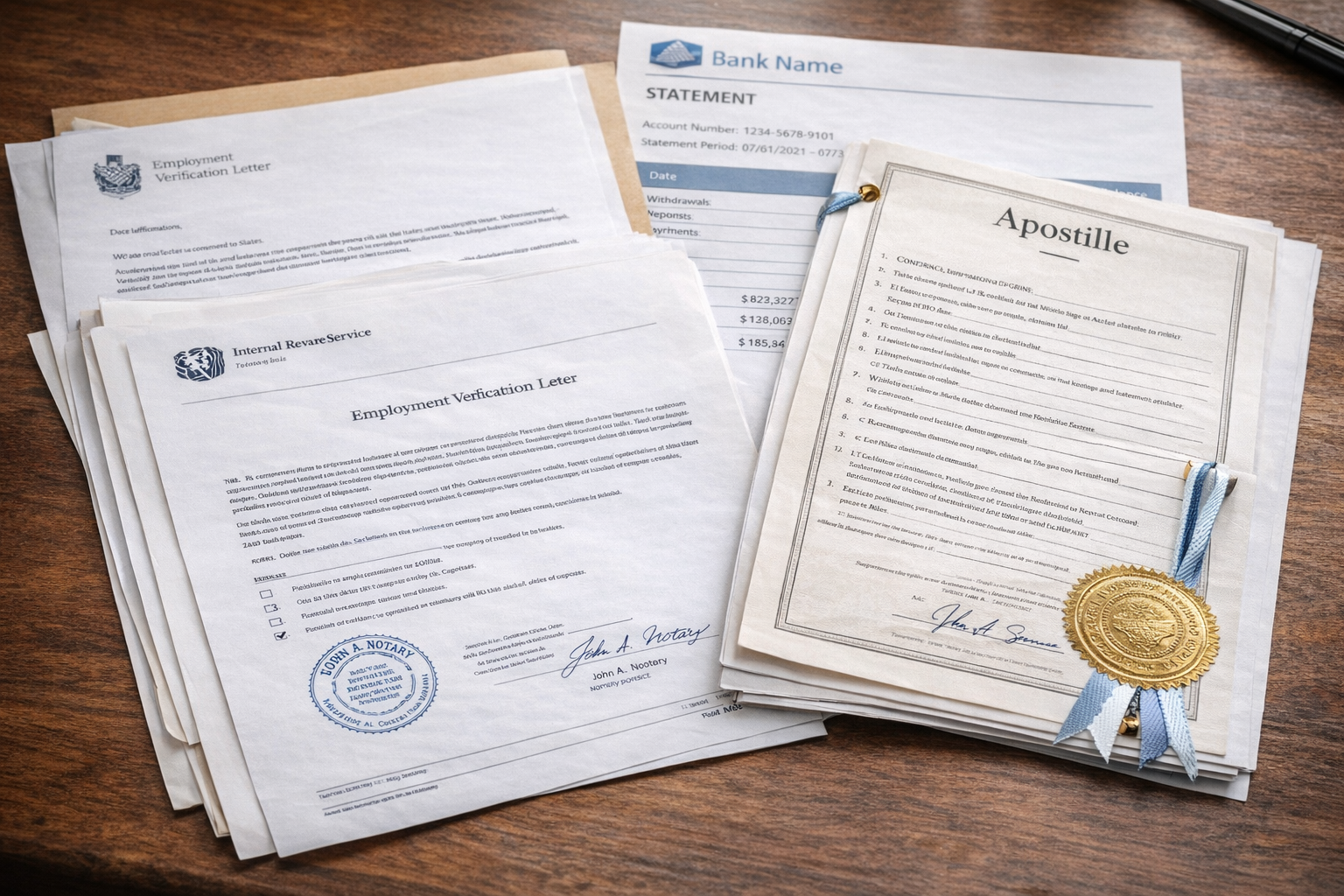
Not every family sponsorship case will require apostilled documents, but some patterns are common. Sponsors may be asked to authenticate:
- Employer letters that confirm job status and salary
- Bank statements used to show liquid assets
- Copies of tax returns or certifications of filing
- The affidavit of support in limited situations
For New Jersey residents, these documents often need to be notarized first and then authenticated at the state level. That is where Apostille New Jersey becomes part of the process. Once financial records have been properly notarized, they can be submitted for review and, if they meet formal requirements, receive the certification that foreign consulates know how to verify.
At the same time, there is another key part of the picture: civil status documents. Birth certificates, marriage licenses and divorce decrees are central to proving family relationships, and they often must be apostilled for consular processing abroad. In those cases, an Apostille Birth Certificate New Jersey request typically starts with a certified copy from the vital records office, not a household photocopy.
Civil Status Records Explained
Financial proof shows that a sponsor can support a relative, but civil records show that the relationship itself is real. For family immigration, consulates rely heavily on:
- Birth certificates to prove parents, children and siblings
- Marriage licenses to prove spousal relationships
- Divorce decrees or death certificates to show how earlier marriages ended
These documents need to be certified by the issuing authority before they can move on to apostille or legalization. For example, a sponsor who needs an Apostille Birth Certificate New Jersey must first obtain an official copy from the state’s vital records office. Once that is in hand, it can be authenticated under the State Of NJ Apostille process so that consular staff abroad can trust it.
Because each document has its own path, certification, notarization if needed, then apostille or consular legalization, it is easy to underestimate how much time this takes. Sponsors who begin gathering and authenticating civil records right after submitting Form I-130 are usually in a better position once the case moves to consular processing.
Building A Sponsorship Timeline
Family sponsorship cases naturally stretch over months, sometimes longer. Much of that time is spent waiting for government agencies to act, but a surprising amount can be used to prepare documents in the background.
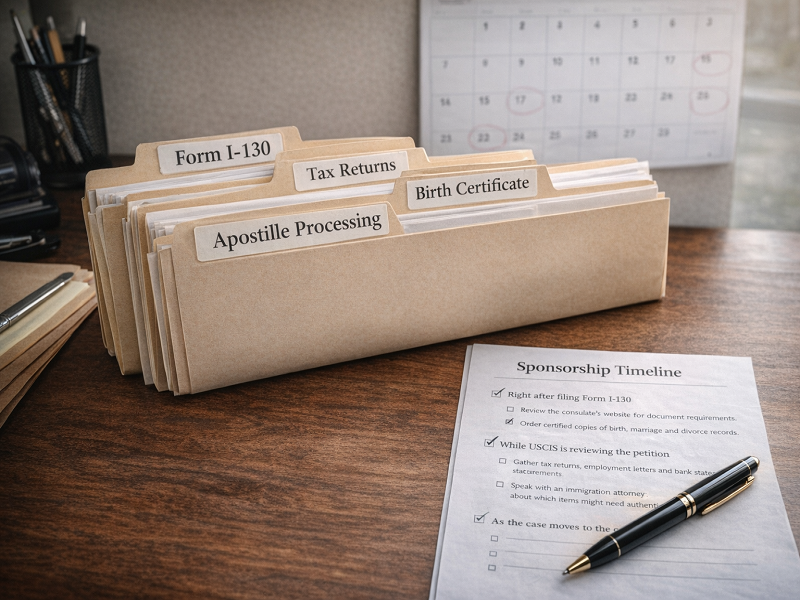
A practical timeline often looks like this:
- Right after filing Form I-130
-
- Review the consulate’s website for document requirements.
- Order certified copies of birth, marriage and divorce records.
- While USCIS is reviewing the petition
- Gather tax returns, employment letters and bank statements.
- Speak with an immigration attorney about which items might need authentication.
- As the case moves to the consulate
- Arrange notarization for financial documents where required.
- Submit records for the State Of NJ Apostille or, if needed, for consular legalization.
This approach reflects how these cases usually play out in practice: processing times can vary, so starting early is wise. It also leaves room for corrections if an issuing office uses an outdated format or if a notary block needs to be adjusted before authentication.

Real Life Sponsorship Scenarios
It is easier to see the value of this preparation with concrete examples. Imagine a New Jersey resident sponsoring a parent who still lives abroad. After Form I-130 is approved, the consulate sends a checklist asking for three years of tax returns, a current employment letter and a bank statement, with a note that certain financial documents should be authenticated. Because the sponsor has already discussed this with an immigration attorney, the employment letter is notarized and submitted through Apostille Services New Jersey well before the interview date. When the consular officer opens the file, the financial record is clear and easy to trust.
Now picture a spouse sponsorship where the couple married in New Jersey but the foreign spouse will interview at a consulate overseas. The consulate requires official copies of the New Jersey marriage license and the sponsor’s birth certificate, both apostilled. By obtaining certified copies early and using Apostille Services New Jersey to move them through state authentication, the couple avoids a last-minute scramble. The officer can focus on the genuineness of the relationship instead of sending the case back for missing paperwork.
In both cases, sponsors who treat document authentication as part of the normal process are less likely to face avoidable delays or requests for evidence that slow their family reunification plans.
Keeping Your Family On Track
Family sponsorship is about more than forms and acronyms; it is about bringing people you care about into the same country and daily life. Strict documentation rules from USCIS and foreign consulates can feel unfriendly, but they exist to make sure financial support is real and relationships are backed by reliable records. When financial documents, birth certificates, marriage licenses and divorce decrees are properly certified and authenticated, they give consular officers what they need to say yes instead of asking for more. That preparation, especially when started soon after filing Form I-130, keeps your case from being slowed down by paperwork that could have been handled in advance.
Our professionals at New Jersey Mobile Notary & Apostille Services work with sponsors who want their documents to support, not hinder, their family cases. We coordinate notarization for employment letters, affidavits of support and other financial records, help clients obtain certified civil documents, and guide those papers through the State Of NJ Apostille process so they are ready for consular review. By combining mobile notary visits with clear guidance on Apostille New Jersey requirements for immigration filings, our role is to keep the administrative side moving so you can focus on your family and the new chapter you are trying to build together.
Commonly Asked Queries
1) Which financial documents are most likely to need apostille for family sponsorship?
Common candidates include employment verification letters, bank statements used to show assets, and in some cases copies of tax returns or income certifications. Exact requirements depend on the consulate and the type of case, so sponsors should always review the instructions for the specific post handling their interview.
2) Do all birth and marriage certificates have to be apostilled for consular processing?
Not always, but many consulates do require apostilled civil records when they were issued in a different jurisdiction from where the interview will take place. Sponsors should check the consulate’s document list; if apostilles are mentioned, official certified copies must usually be obtained first and then authenticated under the Apostille Birth Certificate New Jersey or related processes before being sent abroad.
3) When should sponsors start preparing documents for authentication?
It is usually safest to begin as soon as Form I-130 has been filed and the likely consulate is known. That gives enough time to request certified civil records, collect financial evidence, arrange notarization where needed, and complete the State Of NJ Apostille or consular steps before the interview is scheduled. Starting early reduces the risk of last-minute delays that can push a family member’s visa appointment back by weeks or months.