
 Free Consultation

There is a particular kind of stress that comes from trying to manage important matters in another country while living in New Jersey. Maybe you own an apartment overseas, help parents with their banking back home, or support a sibling through a medical situation in another time zone. Phone calls and emails only go so far. At some point, someone you trust abroad needs the legal authority to act for you, and that is where an international power of attorney (POA) becomes essential.
The challenge is that a POA drafted and signed in New Jersey does not automatically carry weight in a foreign government office or bank. Many institutions will only honor it if the document has been properly notarized and authenticated. Understanding where Apostille New Jersey fits into that process helps you turn a simple POA into something your chosen representative can actually use when it matters.
Why International POAs Matter
A power of attorney is a practical tool: it allows another person to act in your place for specific tasks. When those tasks involve a foreign country, the stakes rise. The person you appoint may need to:
- Sell or manage your property overseas
- Access and manage local bank or investment accounts
- Handle inheritance or family legal matters
- Sign documents for business interests abroad
Foreign governments, banks, and notaries do not know you personally. They rely on paper. If the POA does not look legitimate under their rules, your agent may be turned away at the counter, even if they bring every ID you can think of. That is why proper authentication matters so much: without it, your representative can appear powerless in front of officials who simply cannot accept an unverified document.
Key Risks Without Apostille
For most New Jersey residents, the first indication that there’s something wrong occurs when a deal is made and doesn’t go through. A relative overseas stands in line for hours at a bank, only to be told that the power of attorney is “not valid” in that country. A real estate office won’t carry out a sale or lease due to the fact that the document does not contain the certain certifications they anticipate.
Some of the usual issues with an improperly authenticated POA:
- Officials not taking the document at all
- Local format In some countries the institutions request a new POA.
- Missed court dates, settlement deadlines or payment due dates
- Additional charges for emergency courier services, new notarizations or rushed legal work
Most of these issues trace back to one point: the document never went through the apostille or legalization steps the receiving country requires. Taking time up front for international POA document authentication is often much cheaper and less stressful than trying to repair a broken transaction from thousands of miles away.
Do POAs Need Apostille?
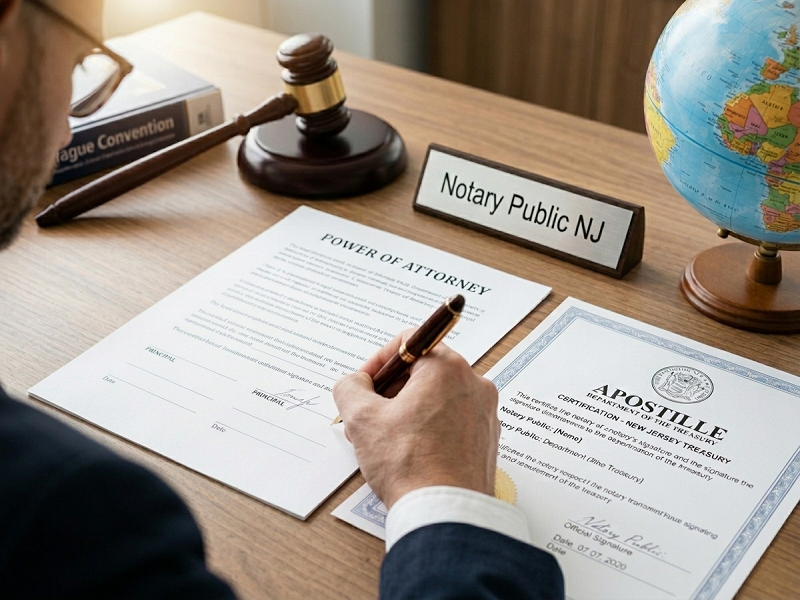
For local use inside the United States, a notarized POA is often enough. For use abroad, many countries go further. Hague Convention countries typically expect an apostille attached to the document, confirming that the notary’s signature is real and that the notary is properly commissioned.
In many situations, the practical path for New Jersey residents looks like this:
- Have the POA drafted in a form that meets both your needs and the foreign country’s requirements.
- Sign it in front of a Notary Public NJ, who verifies your identity and completes the notarial certificate.
- Submit the notarized POA for apostille through the New Jersey Department of the Treasury.
The apostille does not change the wording of your POA. Instead, it certifies the notary’s signature so that officials in other countries can trust the document without having to investigate the notary themselves. In countries that are not part of the Hague system, additional embassy or consular legalization steps are usually required after the state has done its part.

Step By Step Process
Thinking about the process in clear steps makes it easier to manage alongside everything else you are doing for family or property abroad. A typical sequence for a New Jersey resident looks like this:
- Draft the POA
Work with an attorney who understands both New Jersey law and the expectations of the foreign country. In some situations, the foreign consulate or a local lawyer overseas may provide preferred wording.
- Notarize in New Jersey
Sign the document in front of a New Jersey notary public. The notary will check your ID, confirm your willingness to sign, and add the correct notarial language. This notarization is the foundation for later apostille work.
- Request the apostille
Submit the notarized POA, with any required forms and fees, to the state for processing under Apostille New Jersey procedures. The state verifies the notary’s commission and attaches the apostille certificate.
- Consider non-Hague countries
If the document will be used in a non-Hague country, plan for additional embassy or consulate legalization after the state authentication step.
Processing times can vary, but for straightforward cases, apostille work generally takes around five to seven business days, so it makes sense to build at least a week into your planning. For more complex situations, choosing a reliable power of attorney apostille service can help avoid common errors, such as missing signatures or incorrect notary blocks, that lead to rejections.

Realistic POA Situations
The need for an international POA can arise in many ordinary situations. Consider a New Jersey investor who owns an apartment in another country. A buyer appears, but the closing date falls during a period when the investor cannot travel. By preparing a POA in advance and having it properly notarized and processed through the state apostille system, the investor can appoint a trusted local relative to attend the closing, sign documents, and accept funds on their behalf.
Another example: a New Jersey resident has aging parents overseas who rely on them to manage finances and medical paperwork. With a carefully drafted POA that reflects local law, notarized in New Jersey and authenticated through the state and consulate, the resident’s sibling abroad can handle day-to-day matters without constant delays for new signatures. In each case, thoughtful cross border power of attorney planning reduces the risk of urgent problems at moments when travel is difficult or impossible.

Keeping Control From Afar
Granting a power of attorney is about trust. You are giving someone else authority to act in your place, often in situations where you cannot easily step in if something goes wrong. When that authority has to work across borders, paperwork becomes part of that trust. A POA that is properly drafted, notarized, and authenticated reassures institutions abroad that your chosen representative is allowed to act, and reassures you that your instructions will be taken seriously.
Here at New Jersey Mobile Notary & Apostille Services, our crew works with residents who need their documents to function smoothly in other countries. We help people coordinate drafting and signing with their attorneys, arrange appointments with the right Notary Public NJ, and shepherd documents through the state’s apostille process so they are ready to present overseas. By combining mobile notary visits with practical guidance on Apostille New Jersey requirements and the right power of attorney apostille service options, our goal is to keep you in control of your affairs, even when you are managing them from a distance.
Some FAQs
1) What kinds of POAs are most commonly used across borders?
Examples include POAs for selling or managing property abroad, working with local bank or investment accounts, handling inheritance and estate matters, and managing business interests. Some jurisdictions require specific formats or separate POAs for medical decisions, so it is important to check local expectations before you sign.
2) Does a POA always have to be notarized before an apostille?
In most cases, yes. For a power of attorney executed by an individual, notarization is generally the first step, because the apostille will be authenticating the notary’s signature and commission. Some government-issued documents follow different rules, but for a POA that you prepare and sign yourself, planning on having it notarized first is the safest approach.
3) How soon should a New Jersey resident begin the international POA process?
It is wise to start as soon as you know a transaction or family matter overseas will need someone to act on your behalf. That provides time to properly draft the POA, coordinate notarization, complete state apostille work and, if necessary, finish consular legalization before deadlines such as closing dates, court appearances or scheduled travel. The earlier you begin, the less likely a last-minute holdup will leave your agent unable to act when you need them most.