
 Free Consultation

There’s a big gap between developing a new product and protecting it in every market where it might be sold. A breakthrough drug in a New Jersey lab, a clever hardware design in a tech startup, a carefully built brand in a manufacturing business—all of it can be copied or challenged once it appears in overseas markets. Patent and trademark registrations are meant to shield that investment, but they only work if the documents behind them hold up in foreign offices and courts.
Patent examiners in Europe, trademark officials in Asia and regulators in pharma hubs like Switzerland are not going to take a board resolution or assignment agreement at face value. They need proof that it was properly signed, that the company exists and that the rights really belong to the entity making the claim. For New Jersey pharmaceutical giants, tech innovators and manufacturers, treating document authentication as part of everyday IP management, not as an emergency chore, can be the difference between enforcing rights and watching competitors move first.
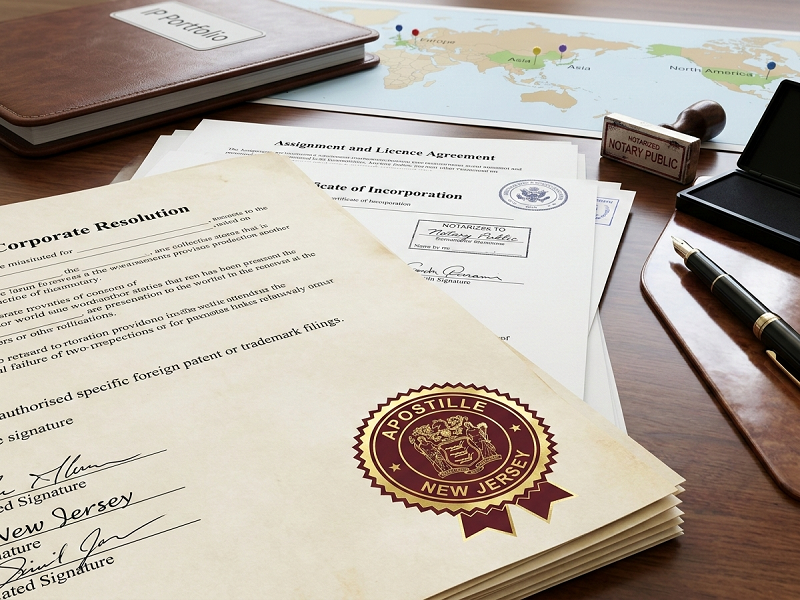
Why Paperwork Protects IP
Intellectual property protection does not begin and end with a patent or a trademark certificate. Behind every filing sits a chain of ownership and authority. Foreign offices want to see how rights moved from inventors to the company, who approved filings in a given country and which entity now owns what.
In practice, that means a lot of supporting records, for example:
- Corporate resolutions authorizing specific foreign patent or trademark filings.
- Inventor or author declarations explaining who created the invention or brand.
- Powers of attorney that allow local agents to act.
- Certificates of incorporation and good standing to prove the owner is real and active.
- Assignment and license agreements that transfer rights between entities.
When these are properly notarized and authenticated, they form a solid foundation for protecting IP in multiple jurisdictions. When they are not, authorities may delay filings, refuse to record transfers or, in the worst case, question who really owns the rights at all.

What Sits Behind Patents
Patent filings are highly technical, but the background documents are just as important. A company seeking protection in several countries at once will typically need:
- An inventor declaration identifying contributors and their relationship to the business.
- A corporate resolution authorizing filings in particular jurisdictions.
- A power of attorney appointing foreign patent counsel.
For many destinations, these documents must be notarized and then authenticated under Apostille New Jersey procedures or through consular channels. The goal is simple: give foreign examiners confidence that the corporation has genuinely approved the filing and that the people signing have the authority to do so.
In jurisdictions that recognize the Hague apostille system, the presence of a State Of NJ Apostille on a resolution or declaration tells officials that New Jersey has verified the notary’s signature and the capacity of the signatory.
Getting Trademarks Taken Seriously
Trademarks and brand assets face similar pressures, especially when companies expand into consumer markets overseas or manufacture in countries where counterfeiting is common. To register or transfer marks, foreign authorities often ask for:
- Verified certificates of incorporation for the current owner.
- Certificates of good standing or similar status documents.
- Legalized assignment agreements when marks move between companies.
These records are part of the wider cross border intellectual property paperwork that proves who stands behind a brand. Some registries will accept notarized and apostilled documents; others demand full consular legalization before making changes to their registers.
This matters in regions where timing is everything. In a manufacturing hub like China, for example, a local business might try to register a similar mark if a foreign brand’s ownership records are stuck in review.
How Do Authentication Rules Differ?
One of the hardest aspects of international IP work is that no two countries treat documents exactly the same way. Broadly speaking, there are three patterns:
- Some states are parties to the Hague Apostille Convention and will accept apostilled documents without further legalization.
- Yet others anticipate consular or embassy legalization, despite the documents having been notarized already.
- Some also have hybrid frameworks or impose stricter standards for specific sectors, such as pharmaceuticals or defense.
For New Jersey executives overseeing portfolios reaching into Switzerland, China, or other significant markets, understanding these distinctions is essential. A resolution that is readily accepted with an apostille in one jurisdiction may require additional stamps and certifications in another. Businesses that build a clear legalization of corporate IP records plan for each major market are less likely to miss filing or renewal deadlines just because a document is sitting in the wrong queue.
Planning A Practical IP Workflow
The safest way to handle all of this is to treat IP paperwork as part of day-to-day operations, not something to fix at the last minute. That means mapping out, early on, which documents will need notarization and authentication whenever the company files or enforces rights overseas. A practical workflow might include:
- Reviewing corporate governance so resolutions supporting foreign IP filings are simple to draft and approve.
- Identifying standard forms for inventor declarations and powers of attorney across key jurisdictions.
- Keeping a central record of which versions of documents have already been notarized and authenticated.
From there, it becomes easier to plug in external support. Many organizations rely on Apostille Services New Jersey to check whether existing documents meet formal requirements and to route them through the appropriate state and consular channels.

Real World Filing Cases
These examples show what is really on the line. Picture a New Jersey pharma company trying to protect a new therapy in Europe and Switzerland: European offices want apostilled inventor declarations and resolutions, and Swiss authorities insist on stricter local authentication. If the company lines up notarized, properly certified resolutions, declarations and powers of attorney before filing, it is much more likely to keep its priority dates and avoid last-minute trouble.
Now consider what that looks like for a mid-sized manufacturer trying to expand through a joint venture with a partner in China. Part of the success of the venture relies on registering and licensing trademarks and designs. Local authorities say they need to see certified certificates of incorporation and assignment agreements before the foreign partner’s rights are recognized.
In either case, New Jersey business that maintains an emphasis on document validation and confirmation are more prepared to protect their patents and trademarks in the global marketplace.
Strengthening Your Competitive Edge
Global IP strategy is not just about filing patents and trademarks; it also means being ready to prove that those rights truly belong to your company. When resolutions, inventor declarations, incorporation papers and assignments are properly authenticated, foreign officials have far less room to doubt your ownership, and competitors have less space to move in.
At New Jersey Mobile Notary & Apostille Services, we assist IP teams, in-house counsel and corporate leadership in organizing those records. We arrange for notarization, assist documents to be passed through the State Of NJ Apostille process or through consular channels and provide responsive guidance on Apostille Services New Jersey requirements so you never miss your deadlines and are able to concentrate on the ideas that fuel your business.
Frequently Asked Queries
1) What documents may require authentication for foreign use?
Examples are Board Resolutions authorizing the application filing of foreign patents or trademarks, declaration of inventor or author, and powers of attorney for local agents. In addition, certified copies of certificates of incorporation, good standing certificates, and assignment or license agreements may be required in authenticated form so foreign offices can verify ownership of the rights being filed or transferred.
2) Do all countries accept apostilles for patent and trademark work?
No. Many jurisdictions that are members of the Hague Apostille Convention will accept apostilled documents without further legalization. Others still require consular or embassy stamps, especially for corporate records. Each patent and trademark office sets its own rules, so requirements should be checked for every country where protection is being sought rather than assuming one approach fits all.
3) When should companies start preparing documents for authentication?
It is safest to begin as soon as the target countries for a filing or enforcement project are known. That timeline allows space to draft and approve resolutions, collect signatures, arrange notarization and complete the State Of NJ Apostille or consular steps before filing or renewal deadlines. Waiting until the last moment increases the risk of missed dates or rushed corrections at the very point when competitors may be watching closely.